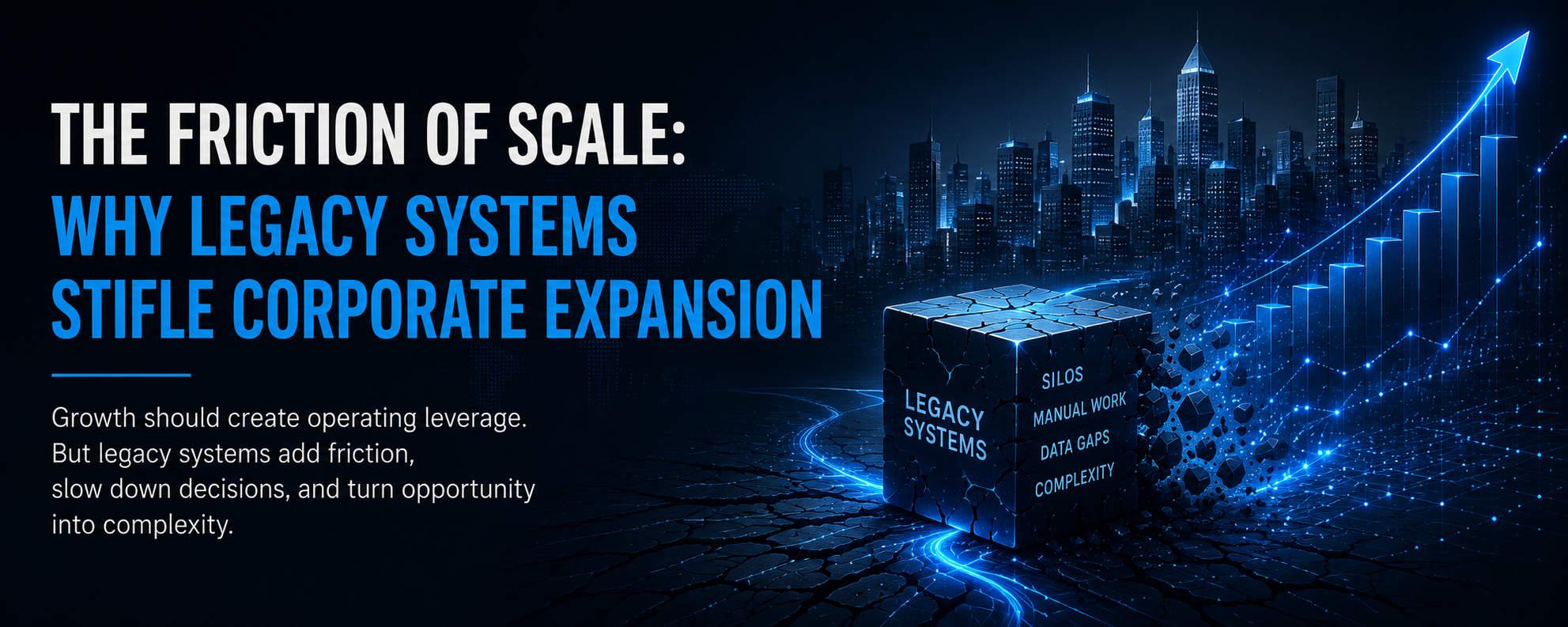
Growth is supposed to create operating leverage. Revenue expands faster than overhead, fixed costs are absorbed across a larger base, and each new market adds incremental value to a proven operating model.
Yet beyond a certain threshold, many successful enterprises experience the exact opposite.
The next subsidiary takes longer to integrate than the last. Group consolidation grows increasingly labor-intensive. A new functional currency adds another reconciliation layer. Local statutory requirements generate another offline spreadsheet outside the core platform. Intercompany balances demand complex manual eliminations. Management reporting slows precisely when leadership requires real-time visibility across a geographically dispersed footprint.
The business is growing, but its operating architecture is accumulating friction faster than it is creating leverage.
This is the central scaling trap facing mid-market and enterprise organizations. The accounting platform, customized ERP, or collection of localized tools that supported early expansion was engineered for a specific level of complexity. Once the enterprise crosses that threshold, the question is no longer whether those legacy systems still process transactions.
The real question is whether they can absorb the next layer of complexity without forcing the organization to pay for it in time, control, capital, and management capacity.
The Scaling Paradox: When Growth Multiplies Complexity
Revenue growth is linear on an income statement; operational complexity rarely is.
A company expanding from one market to three does not simply process three times as many transactions. It suddenly operates across multiple legal entities, functional currencies, statutory frameworks, tax jurisdictions, banking structures, charts of accounts, and reporting calendars.
Cross-border structures introduce compounding requirements across treasury, statutory accounting, consolidated reporting, foreign exchange, local GAAP, tax, intercompany debt, and entity consolidation. PwC notes that corporate restructuring associated with acquisitions, regional realignment, and expansion into new markets can trigger these requirements simultaneously, with detailed restructuring plans potentially involving hundreds of individual transaction steps requiring accounting evaluation.1
This creates a distinction that matters at the board level:
Transaction volume tests system capacity. Corporate expansion tests system architecture.
A database may accommodate another million transactions. The harder question is whether the underlying operating model can execute those transactions across multiple entities while preserving common controls, master data integrity, local statutory compliance, and consolidated financial visibility.
This is where systems that appeared perfectly adequate at one stage of corporate maturity begin to impose a hidden tax on the next.
Technical Debt Has an Interest Rate
Legacy technology rarely appears on the balance sheet as a liability, but economically, it behaves like one.
McKinsey separates technical debt into principal and interest. The principal represents modernization work that has been deferred. The interest is the recurring complexity tax paid every time the organization must navigate fragile integrations, harmonize non-standard datasets, or build another workaround around aging architecture.
In McKinsey’s research, CIOs estimated technical debt at 20% to 40% of the value of their entire technology estate before depreciation, while 10% to 20% of technology budgets intended for new products were being diverted to resolving technical-debt issues. At the extreme, McKinsey identifies a dangerous threshold: when more than half of an IT project’s budget is consumed by integrations and repairs to legacy systems, the organization may have entered a technical-debt spiral, effectively paying interest on yesterday’s architecture instead of funding tomorrow’s capabilities.2
Deloitte’s 2026 Global Technology Leadership Study places the burden at a similar scale across the broader technology estate, estimating that technical debt accounts for 21% to 40% of organizational IT spending. Separately, nearly 60% of leaders responding to Deloitte’s 2025 Tech Value Survey believe that another 21% to 50% of value remains trapped within their existing technology, data, and people capabilities.3
The strategic implication is significant:
The true cost of a legacy platform is not its annual maintenance fee. It is the cumulative opportunity cost of every market entry, acquisition, and operating-model change that becomes harder because the architecture underneath cannot adapt cleanly.
The Legacy Multiplier: One Exception Becomes Fifty
The first workaround rarely looks dangerous.
A newly acquired subsidiary keeps its legacy chart of accounts until integration is complete. Finance builds a temporary mapping table for consolidation. A regional operation requires a tax treatment the core system cannot process, so a local spreadsheet bridges the gap. Treasury handles a new currency through an offline workflow. Management requests custom reporting, and another extraction layer is added.
Individually, each decision can be rational.
Collectively, they change the economics of scale.
As expansion accelerates, exceptions begin interacting with exceptions. Multiple charts of accounts demand increasingly complex mapping logic. Misaligned closing calendars delay group reporting. Entity-specific master data complicates consolidation. Intercompany transactions generate reconciliation queues. Local applications require another generation of point-to-point interfaces.
McKinsey identifies precisely these conditions among the drivers of technical debt: insufficient integration during M&A, inadequate standardization across regions performing similar processes, multiple applications performing the same function, heavily customized packages, inconsistent data models, and proliferating point-to-point integrations.4
At that point, the enterprise is no longer scaling its operating model.
It is scaling its exceptions.
And every exception creates another structural dependency that must be maintained during the next phase of growth.
The $370 Million Warning: The Cost of Running to Stand Still
The scale of that burden becomes clearer when legacy dependency is measured across large enterprises.
A 2025 study conducted by Savanta for Pegasystems surveyed more than 500 IT decision-makers across global enterprises and estimated the average annual cost associated with technical debt at more than $370 million per enterprise. Within that estimate, approximately $134 million was attributed to the time required to complete legacy transformation projects, $58 million to time invested in failed transformation initiatives, and $56 million to maintaining, updating, and integrating legacy applications.5
The dependency itself is equally revealing. 63% of respondents reported relying on between one and ten legacy applications in front- and back-office operations on a typical day, while another 29% relied on eleven to twenty. Only 9% said their transformation efforts had reached a point where all legacy applications could be fully retired or replaced. Most tellingly, 78% agreed that the time, money, and effort consumed maintaining legacy applications could be deployed more productively elsewhere.6
The monetary figures are modeled estimates rather than audited corporate losses, but the underlying allocation problem matters.
Growth capital is not consumed only by factories, talent, inventory, and market entry. Executive attention and technology capacity are capital, too. When those resources are continuously diverted toward keeping a fragile architecture operational, the company begins financing its past at the expense of its expansion.
When Acquisition Growth Creates an ERP Estate
Few examples illustrate this compounding friction more clearly than the global industrial enterprise documented in a PwC finance transformation case study.
Years of aggressive acquisitions had produced an organization operating with hundreds of separate ERP instances, finance organizations that had never been fully integrated after prior deals, no standard processes, and no common data strategy. What had once supported an autonomous acquisition model eventually produced finance costs high enough that the company needed a company-wide transformation to continue its acquisition strategy with faster synergy realization and time-to-value.7
The scale of the rationalization is instructive.
The company consolidated more than 500 ERP instances to 37, established a standard chart of accounts across business units, aligned close calendars, streamlined intercompany processes, and created a cloud-based shared-services ERP hub. PwC reports that three businesses across four countries were migrated from aging legacy platforms in nine months.8
The measurable results were substantial: a 30% reduction in overall finance spend and a 25% faster close cycle. More importantly for the growth argument, the new foundation positioned the organization to integrate future acquisitions faster and accelerate value realization.9
This case exposes an important distinction between growth and scalable growth.
Acquisitions can add revenue immediately. But when every deal adds another ERP instance, another data model, another finance organization, and another consolidation layer, the enterprise simultaneously accumulates integration liabilities.
Eventually, the architecture begins setting the pace of the acquisition strategy.
The Multi-Entity Threshold: Standardize the Core, Localize the Edge
A scalable enterprise architecture does not require every subsidiary to operate identically. Across jurisdictions, absolute uniformity is neither practical nor desirable.
The objective is to distinguish between legitimate localization and accidental variation.
A subsidiary may legitimately require a different functional currency, statutory reporting framework, tax configuration, or regulatory workflow. Those differences belong at the local edge of the operating model.
Core definitions require a different discipline. Customer and supplier master data, product hierarchies, chart-of-accounts logic, approval authority, intercompany rules, consolidation structures, and management-reporting dimensions need sufficient standardization to preserve group-level control.
This is where a modern enterprise platform diverges materially from a patchwork of locally effective applications. Its scaling value lies in absorbing multi-entity complexity inside a governed architecture: multiple companies, currencies, ledgers, tax structures, reporting dimensions, and approval hierarchies can operate according to legitimate local requirements while remaining reconcilable centrally.
Without that distinction, headquarters receives local numbers that may each be technically correct and then spends days determining how they fit together.
The challenge intensifies as the corporate structure evolves. PwC highlights foreign-currency gains and losses, local GAAP differences, intercompany debt, entity consolidation and deconsolidation, tax consequences, and reporting changes among the accounting complexities that can accompany cross-border restructuring and expansion.10
A scalable architecture therefore has to solve two apparently opposing requirements at once:
Local compliance without fragmentation, and global standardization without rigidity.
A 15-Year-Old ERP Meets a Ten-Country Enterprise
The point at which this tension becomes unsustainable is visible in a multinational manufacturing case documented by EY.
The manufacturer operated in more than ten countries while relying on an ERP implemented approximately 15 years earlier. Over time, individual locations had developed customized versions of the platform, while different geographies and functions added non-standard applications around it. The result was inconsistent data, rising maintenance demands, and reporting inconsistencies across the organization.11
The significance of the case is not that the old ERP suddenly stopped processing transactions.
The company undertook the transformation in the context of its future growth and expansion plans. Supporting those ambitions required a more standardized information architecture spanning finance, sales, procurement, inventory, production, quality, and plant maintenance. EY reports that the implementation was completed within 12 months, creating greater standardization across processes and management reporting.12
Legacy systems rarely announce their obsolescence through total system failure.
They reveal it through the sheer volume of organizational effort required to keep the business moving.
Elastic Architecture: Designing for the Company That Does Not Exist Yet
Executive teams evaluating enterprise architecture therefore need to look beyond current transactional volume.
A platform may comfortably support three entities, two currencies, and one manufacturing site today. That offers little evidence that the same architecture can support a regional acquisition in eighteen months, a shared-services model, ten additional legal entities, a new reporting regime, or materially higher transaction concurrency without another layer of custom code.
Scalability is not server capacity. It is the ability to absorb organizational complexity without producing a proportional increase in operational friction.
An elastic enterprise core should allow new subsidiaries to enter governed master-data structures rather than create parallel ones. Approval and authorization frameworks should extend across new entities without being rebuilt locally. Multi-currency accounting, intercompany processing, eliminations, and consolidation should become native operating capabilities rather than month-end reconciliation projects. Auditability should survive geographic expansion instead of deteriorating with every additional jurisdiction.
The financial return compounds because the architecture stops charging the organization a new complexity premium every time it grows.
Deloitte’s system-dynamics modeling illustrates that compounding effect. In its comparison of two simulated enterprises, infrastructure modernization reduced technical debt by 18% over five years relative to the average organization. Separately, a modeled 35% increase in data capability resulted in progressively less trapped latent potential, reaching 52.5% less than the average organization by year five. Deloitte explicitly frames these as modeled outcomes rather than universal benchmarks, but the direction is important: sustained modernization can progressively release capacity already trapped inside the existing technology estate.13
This is the architecture of operating leverage: commercial output can scale without forcing complexity to scale at the same rate.
The Executive Mandate: Measure the Cost of the Next Entity
Legacy-system evaluations are frequently framed around software replacement costs.
That is the wrong denominator.
For an expanding enterprise, leadership should evaluate the marginal cost of complexity: how much additional finance capacity, IT integration, reconciliation effort, custom development,
reporting latency, compliance exposure, and management attention is required every time the organization adds another market, subsidiary, currency, acquisition, or business model.
When those marginal costs begin rising faster than the business itself, the architecture has crossed from enterprise asset to corporate constraint.
Modernizing enterprise architecture is therefore not simply a software replacement exercise. It is an attempt to restore operating leverage—to ensure that the tenth entity is not ten times harder to govern than the first, that the next acquisition does not create another permanent reconciliation layer, and that regional expansion adds commercial reach without multiplying structural debt.
A successful company can outgrow the architecture that made it successful.
The danger lies in discovering that only after the next stage of growth has already begun.
Before committing capital to the next acquisition, regional launch, or legal-entity expansion, executive leadership should ask one fundamental question:
If our operational complexity doubles over the next three years, will our platform absorb that growth? Or will we have to build another layer of spreadsheets, integrations, and human workarounds just to keep the enterprise running?