Every management meeting eventually comes down to numbers.
What did we sell? Which products are truly profitable? How much inventory do we need? What do customers owe us? Where is working capital being tied up? Are margins improving? Can the business afford its next expansion?
Executives expect dashboards and reports to answer these questions. But confidence in those answers begins much earlier.
Can the underlying data be trusted?
A profitability report built on incorrect product costs can point management toward the wrong products. An inaccurate customer balance can distort credit exposure. Incorrect inventory data can trigger unnecessary purchasing—or leave the business without enough stock to meet demand.
The quality of management decisions therefore depends on the quality of the information beneath them.
Better data → better information → better decisions.
Before Reporting Comes Data
An ERP contains several layers of information that collectively describe how the business operates.
At the foundation is master data: the relatively stable records repeatedly used across the organization. Customers, suppliers, products, materials, chart-of-account structures, warehouses, units of measure, payment terms, and other core business entities all belong here.
Then comes transactional data: sales orders, purchase orders, invoices, receipts, payments, inventory movements, journal entries, returns, and the continuous flow of activity generated as the company operates.
During an ERP implementation or migration, opening balances establish the financial and operational starting position of the new system, including customer and supplier balances, general ledger balances, bank positions, and inventory quantities and values.
If a customer actually owes 30,000 but an opening balance of 3,000 is migrated, the ERP begins from the wrong financial position. Management may underestimate receivables, customer exposure, and expected cash collection from day one.
The same effect travels across the enterprise. Incorrect product costs distort profitability. Wrong inventory balances affect purchasing and working capital. Inaccurate payment terms change cash-flow expectations. Poorly classified transactions weaken forecasts and management analysis.
What begins as a data-quality problem can quickly become a business-performance problem.
Small Data Errors, Expensive Business Consequences
Poor data quality rarely arrives as one dramatic failure. More often, it accumulates through ordinary transactions.
Consider a call center where employees create a new customer record whenever someone calls rather than checking whether that customer already exists. One customer calls five times, and the ERP effectively sees five customers.
Sales history and outstanding balances become fragmented across records. Management can no longer see the customer’s complete commercial relationship or accurately assess credit exposure.
A formatting error can be equally damaging. Depending on system configuration and regional conventions, 3.000 and 3000 can represent radically different values. Enter that difference into a quantity, unit cost, exchange rate, or balance and a tiny input error can materially distort inventory valuation, margins, purchasing requirements, or financial positions.
Or consider a product purchased in boxes but sold in individual units. An incorrect unit-of-measure conversion can make inventory appear sufficient when the warehouse is physically short, leading to missed sales or fulfillment problems. The reverse can trigger unnecessary purchasing and tie up working capital in excess stock.
Even duplicate supplier records have management consequences. Splitting purchases between multiple profiles for the same supplier can understate supplier concentration, fragment spend analysis, and weaken purchasing negotiations.
These are small errors at the point of entry. Their financial consequences can be much larger at the point of decision.
Data Governance Is Management Control
Reliable data does not happen simply because an organization has implemented ERP.
It requires governance.
Who can create a customer or supplier? Which fields must be completed before a record is approved? Who owns product master data? How are duplicate records prevented or merged? Who validates changes to payment terms, credit limits, units of measure, or account structures?
For critical master data, organizations need clear ownership, defined approval processes, validation rules, and ongoing governance.
These controls are not administrative bureaucracy. They are part of the company’s internal management framework.
A customer credit limit can influence how much financial exposure the business accepts. A product cost can influence pricing and margin decisions. Supplier terms affect cash requirements. Product classifications can shape profitability analysis and investment decisions.
When these records are poorly governed, management may be making disciplined decisions using unreliable inputs.
ERP provides the structure to establish consistent information and controlled processes across the enterprise. But technology cannot replace accountability for the data entering it.
ERP Is the Foundation of Reporting
ERP systems provide valuable operational and financial reporting. But for deeper analytics, organizations increasingly connect ERP data with specialized business intelligence platforms such as Microsoft Power BI.
The distinction matters.
The ERP records and structures the underlying business activity. Business intelligence tools then use that information to analyze performance, identify trends, compare scenarios, visualize results, and support management decisions.
The relationship can be understood as a simple management information chain:
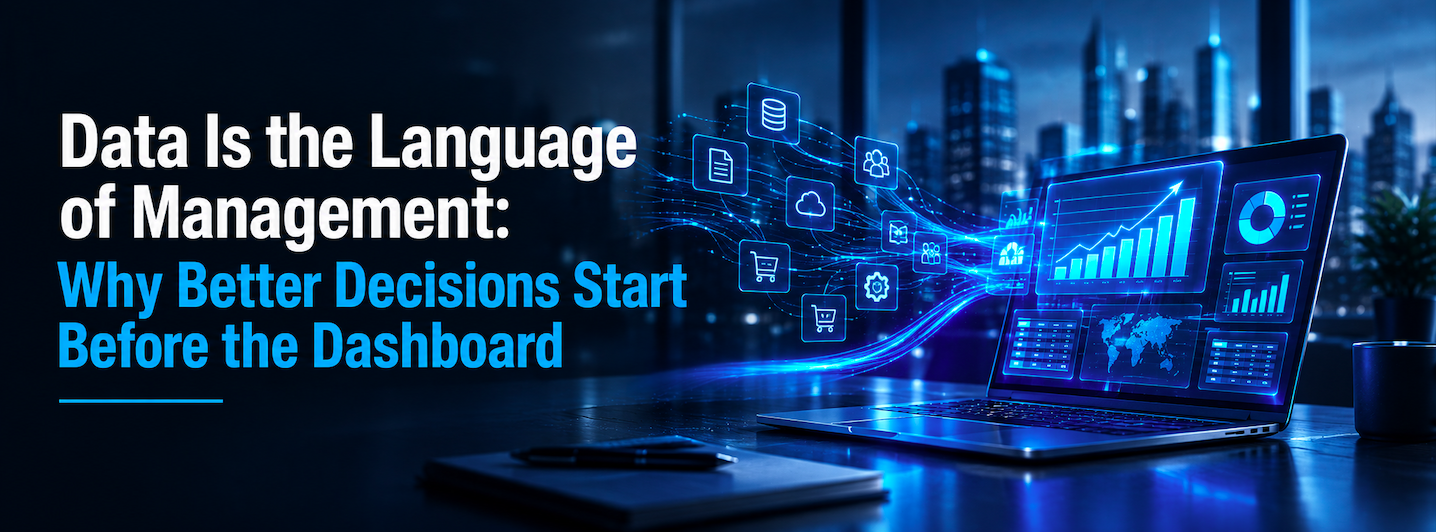
Master Data → Transactions → ERP → Business Intelligence → Management Decision
Each stage inherits the quality of the one before it.
A sophisticated dashboard may calculate gross margin perfectly. But if the ERP receives an incorrect product cost, the calculation is perfectly applied to the wrong economic reality.
The same principle affects forecasting, inventory planning, customer credit analysis, purchasing decisions, working-capital management, and investment planning.
This is why the ERP should be viewed not simply as another source feeding a dashboard, but as a trusted data foundation for management reporting and business control.
From Reporting Confidence to Management Confidence
When Finance, Sales, and Operations arrive at a management meeting with different numbers, the visible problem is disagreement.
The deeper problem is uncertainty.
Which figure should leadership trust? Which customer balance is correct? Which margin reflects the actual cost? Which inventory position should drive purchasing? Which forecast should determine the next investment?
Once executives begin questioning the integrity of the underlying information, every decision requires additional reconciliation, explanation, and judgment.
Reliable management information starts much earlier: when a customer is created correctly, a product is classified consistently, an invoice is posted against the right account, an inventory movement is recorded at the right time, and opening balances accurately represent the business.
That is why ERP implementation is not only about configuring processes and migrating records. It is about establishing a trusted representation of the enterprise, one management can confidently use to control performance and make decisions.
Because the ultimate value of better data is not a cleaner database or a better-looking dashboard.
It is greater confidence in the decisions that determine where the business goes next.
Before asking whether your dashboard is giving management the right answers, ask the question that comes first:
Is your ERP recording the right reality?