Every executive can identify the external forces that threaten profitability. Inflation compresses margins, supply chain disruptions increase costs, interest rates reshape investment decisions, and competitive pressure demands greater efficiency with fewer resources. These forces dominate boardroom discussions because they originate outside the organization and can be monitored through familiar financial and market indicators.
Yet many organizations overlook a different category of cost, one that is neither imposed by the market nor recorded as a discrete expense on the income statement. It accumulates quietly inside the enterprise itself, hidden within routine operations, where information moves from one department to another.
This cost rarely appears as a single event. It surfaces instead as delayed approvals, duplicated work, conflicting reports, manual reconciliations, inconsistent forecasts, and decisions made using incomplete information. Each incident appears insignificant on its own, easily explained away as part of the normal complexity of running a business. Collectively, however, they form a persistent economic burden that steadily erodes profitability without attracting the attention given to more visible operational costs.
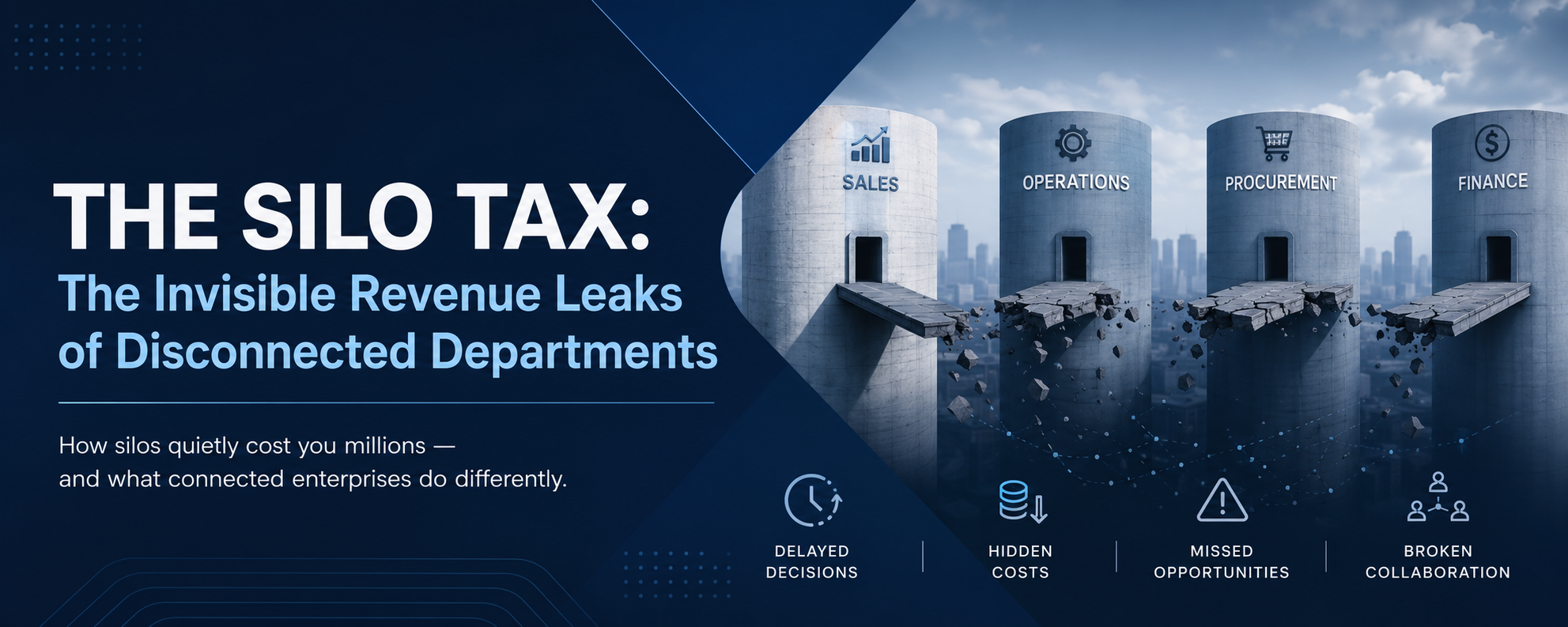
This hidden burden can be described as the Silo Tax.
Unlike statutory taxes, the Silo Tax is entirely self-imposed. Organizations pay it every time work crosses a functional boundary without the information, context, or accountability required to continue seamlessly. It represents the direct financial consequence of fragmented execution. Departments frequently perform exceptionally well individually while the enterprise as a whole grows progressively less efficient.
This distinction matters because most organizations continue to evaluate performance through a functional lens. Sales is measured by revenue growth, Procurement by purchasing savings, Manufacturing by production efficiency, and Finance by reporting accuracy and compliance. Each department is encouraged to optimize its own objectives, improve its own metrics, and deliver stronger results within its own scope of responsibility.
From the perspective of individual departments, this management philosophy appears entirely rational. From the perspective of the enterprise, it frequently produces opposing, counterproductive outcomes.
Local vs. Global Optimization
Systems theory has long recognized the fundamental difference between local optimization and global optimization. Improving the performance of individual components does not guarantee an improved outcome for the broader system. In practice, optimizing one component frequently transfers complexity and cost directly to another:
- Procurement teams rewarded primarily for reducing unit costs often negotiate larger purchasing volumes that successfully lower supplier pricing while simultaneously increasing inventory carrying costs and tying up critical working capital.
- Commercial teams pursuing aggressive customer acquisition frequently introduce highly customized commercial agreements that accelerate bookings while creating severe operational complexity for fulfillment and Finance.
- Manufacturing divisions often maximize asset utilization through extended production runs, generating inventory that exceeds current market demand and degrades the Cash Conversion Cycle (CCC).
Every department achieves its isolated target. The enterprise absorbs the structural trade-offs.
Long-standing research from the Harvard Business Review underscores this structural breakdown, revealing that functional silos create organizational “blind spots” where up to 75% of corporate friction occurs during cross-departmental handoffs instead of individual task execution.1
This reality calls for balance rather than an abandonment of specialization. Modern organizations depend on specialized expertise, and functional excellence remains essential to competitive performance. The core breakdown occurs when leadership mistakes localized functional excellence for overall enterprise strength.
The Flow of Value Streams
Customers do not experience departments. They experience end-to-end processes.
A customer request becomes a quotation. A quotation becomes an order. An order initiates procurement, production, logistics, invoicing, and eventually payment. From the customer’s perspective, these activities represent a single continuous experience. Internally, however, they traverse critical Enterprise Value Streams.
The enterprise creates true value in the seamless flow between departments rather than inside the departments themselves. Uninterrupted operational flow allows organizations to scale efficiently. Information travels at the same velocity as physical operations. Decisions stem from real-time
conditions instead of outdated assumptions. Commercial commitments translate directly into operational actions without manual intervention or contextual translation.
When that flow becomes fragmented, operational friction accumulates across two distinct categories:
- Transaction Latency: The time gap between a physical business event occurring and its digital representation updating across core operating systems.
- Information Entropy: The gradual loss of data accuracy and contextual nuance occurring whenever information is manually re-keyed, exported to spreadsheets, or transferred via email across departmental boundaries.
Diagnosing the Silo Tax: Data & Benchmarks
The challenge stems from the reality that operational friction rarely manifests where it originates. A delayed pricing update in Sales eventually appears as an invoicing dispute in Finance. An outdated demand forecast in Commercial later turns into excess inventory in the warehouse. A production change that fails to reach Procurement in time drives up expedited freight costs weeks later. By the time these consequences surface in financial reporting, the operational trigger has vanished into the routine daily activity of multiple departments.
Empirical research across mid-market and global enterprises quantifies the severe scale of this disconnect:
- McKinsey & Company: Research shows that executives spend up to 70% of their time on decision-making and cross-functional coordination, with 61% reporting that more than half of that time is spent ineffectively. In siloed organizations, high-value executive capacity is squandered on reconciling conflicting departmental data and navigating complex approval layers instead of executing strategic initiatives.2
- Gartner: Research on enterprise data quality shows that poor data integration and siloed information architectures cost organizations an average of $12.9 million annually in operational inefficiency, delayed decision-making, and wasted labor.3
- APQC: Benchmarking data demonstrates that top-performing enterprises collect payment in 30 days or less, whereas bottom-quartile organizations with fragmented
Order-to-Cash processes require 46 days or longer to settle customer invoices, locking up critical working capital.4
Executive Diagnostic: Signals of Enterprise Fragmentation
| Executive Warning Sign | Operational Root Cause | Financial & Strategic Consequence (Industry Research) |
|---|---|---|
| The “Shadow Middleware” Layer | Analysts spend 10–15 hours/week exporting, cleaning, and merging CSVs across departments. |
Wasted high-value executive payroll; high human error rates; 5- to 7-day delays in monthly financial close. |
| Transaction & Decision Latency | Commercial contract amendments take days to manually update operational and material planning systems. |
Unplanned expedited freight costs; production line re-tooling; 1.5% to 3% direct margin leakage on custom orders. |
| Boardroom Data Wars | Sales, Finance, and Ops present conflicting definitions of “Active Revenue” or “Fulfillment Capacity.” | Strategic paralysis; prolonged board alignment cycles; capital misallocation based on stale assumptions. |
The challenge compounds because workforce teams demonstrate remarkable adaptability in working around broken processes. Lacking timely digital information, employees create manual workarounds. They export spreadsheets, maintain shadow databases, exchange static email reports, reconcile conflicting numbers before executive meetings, and manually validate information that should exist as a single source of truth.
Over time, these manual interventions embed themselves into the organization’s operating rhythm. Employees stop viewing them as operational flaws, accepting them instead as standard operating procedures.
That exact normalization drives up the cost of the Silo Tax. Organizations operate under the assumption that they are managing business complexity, when they are simply subsidizing operational fragmentation.
The Cost of Management Friction
The financial implications of enterprise fragmentation extend far beyond immediate operational inconvenience.
Research from MIT Sloan Management Review on operational agility demonstrates that legacy, siloed architecture creates a distinct “agility penalty”, forcing enterprise teams to spend up to 4x more time on manual integration and process workarounds compared to peers operating with unified digital cores.5
When departments maintain conflicting versions of commercial reality, executive teams spend critical hours debating data validity prior to discussing strategic action. Board meetings devolve into exercises in data reconciliation instead of decisive governance. Planning cycles lengthen as executive confidence in internal information drops. Market uncertainty causes fewer strategic delays than internal operational ambiguity.
The Target Canada Warning
Target Canada offers a powerful case study in how fragmented information and execution undermine an entire enterprise.
Post-mortem reporting found that the company struggled with incorrect product and shelf data, unreliable replenishment processes, and severe forecasting errors. Stores faced empty shelves while distribution centers were overloaded with inventory. Because the automated replenishment system proved unreliable, employees were required to check shelves and replenish products manually.
Target publicly acknowledged significant inventory and operational challenges, concluding that the Canadian business could not reach profitability within an acceptable timeline. The company closed 133 stores and recorded approximately $5.1 billion in pretax impairment losses and related charges in early 2015.
The expansion did not fail due to a single isolated system or team. It failed due to a breakdown in synchronized enterprise execution.6
Technology Connects Systems; Governance Connects Accountability
The instinctive response to operational friction often centers on software acquisition. Organizations purchase new applications, build point-to-point system integrations, or automate localized departmental workflows. These initiatives improve point efficiency without necessarily eliminating the Silo Tax.
Software integrates databases. Governance aligns human decisions.
An organization can successfully integrate its CRM, finance platform, warehouse management system, and manufacturing applications while continuing to govern each function in isolation. Information moves faster between databases, yet corporate decisions remain fragmented because individual departments continue pursuing conflicting objectives. Software integration does not automatically produce organizational alignment.
This distinction separates ERP initiatives that achieve transformational business outcomes from those that yield only minor efficiency gains. Success depends on whether leadership uses enterprise technology to reinforce existing departmental boundaries or to structurally redesign how the enterprise operates across them.
Viewed through this lens, the strategic definition of ERP evolves:
An ERP functions as a unified enterprise operating model through which Sales, Operations, Procurement, and Finance execute within the same end-to-end value stream, moving beyond the traditional framework of a simple database or software suite.
The Silo Tax represents a structural governance issue rather than an IT infrastructure challenge. The organizations that eliminate it most effectively look beyond technology budgets. They focus on a fundamental operational principle: enterprise performance depends on how effectively departments execute together, rather than how efficiently they operate in isolation.
Prior to pursuing margin expansion, revenue growth, or productivity improvements, executive teams must evaluate a fundamental operational bottleneck:
Where does work slow down when it leaves one department and enters another?
That cross-functional friction marks the exact location where the Silo Tax is collected, and inside most enterprises, the bill is substantially higher than leadership realizes.